
Daily cycle journeys in London rose 10.1% in 2026 to a record 1.66 million. In Ealing, 35% of people live within 400m of the Strategic Cycle Network.
Cycling in London reached a record 1.66 million journeys a day in 2026, Transport for London (TfL) said on Wednesday, and 35.0 per cent of Ealing residents live within 400 metres of the Strategic Cycle Network that TfL credits for the growth. Across London the figure is 30 per cent.
The London-wide numbers come from TfL’s latest Travel in London report. Daily cycle journeys rose 10.1 per cent from 1.50 million in 2025, passing the target of 1.6 million daily cycle journey stages that TfL and the Mayor had set for 2030, four years early. They have now set a new aim of 2.4 million a day by 2035.
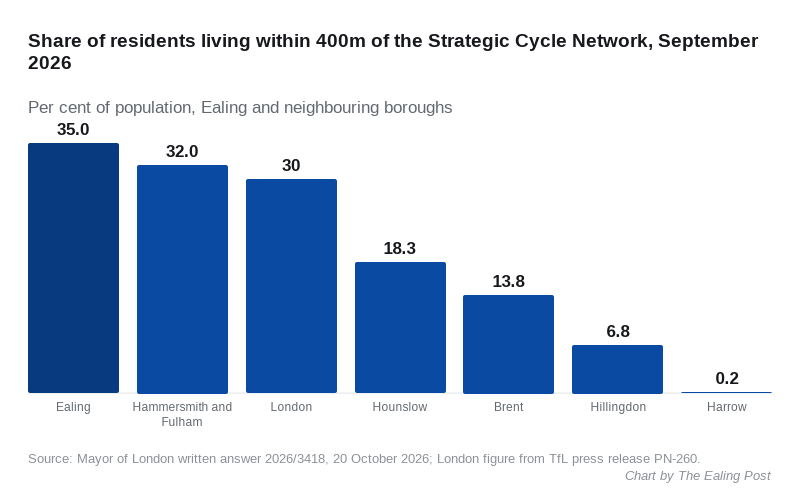
The Ealing figure is from a written answer by the Mayor, dated 20 October 2026, to a question from London Assembly Member Caroline Russell. It gives each borough’s share of residents within 400m of the network in September 2026. In Ealing, 33.2 per cent live within 400m of a route on borough roads and 3.7 per cent within 400m of one on TfL’s own roads; some live near both. That puts Ealing 15th of London’s 33 boroughs and ahead of all its neighbours: Hammersmith and Fulham is at 32.0 per cent, Hounslow 18.3 per cent, Brent 13.8 per cent, Hillingdon 6.8 per cent and Harrow 0.2 per cent.
Overview
- Daily cycle journeys in London in 2026: 1.66 million, up 10.1 per cent on 2025 and 57.7 per cent higher than in 2019.
- Target: 1.6 million daily journey stages by 2030, reached in 2026. New aim: 2.4 million by 2035.
- Strategic Cycle Network: 451km in September 2026; 30 per cent of Londoners live within 400 metres of it.
- Ealing: 35.0 per cent of residents within 400 metres of the network in September 2026.
- Target for routes: 40 per cent of Londoners within 400m of a Cycleway by 2030.
What the report shows
TfL counts cycling two ways. Daily cycle journey stages, the measure used for the target, rose from 1.50 million in 2025 to 1.66 million in 2026. Daily cycle trips rose from 1.41 million to 1.55 million.
TfL launched 15 new Cycleway routes in 2025/26. The recent schemes it names are the first 1.4km of Cycleway 68 between St Helier and Morden in Sutton, which gives a new link to St Helier Hospital, an upgrade to Cycleway 8 on Queenstown Road in Wandsworth and work around Lambeth Bridge on Cycleway 62. The Cycleway 4 extension, Cycleway 34 and the Streatham and Nine Elms Healthy Streets corridors are due to finish in 2027. None of the schemes in the release are in Ealing.
TfL’s Safe and Healthy Streets funding puts £158m into roads for people cycling, walking and using public transport. More than half goes through the boroughs, including up to £15m a year to help boroughs extend the Cycleway network in their own areas. TfL has completed work at 48 Safer Junctions so far.
The full Travel in London 2025 Annual Overview will be published with the papers for the TfL Board meeting on Wednesday 2 December.
Trains and walking
Overall TfL ridership fell by 1.7 per cent in 2025/26. Elizabeth line ridership rose by 4.9 per cent, and London Overground ridership rose by four per cent.
Average hourly pedestrian flows in central London in 2026 were similar to the previous three years. City Hall figures showed footfall on the traffic-free stretch of Oxford Street between Orchard Street and Great Portland Street rose by 16 per cent compared with October 2025 half-term, after it closed to traffic on 26 October.
What they said
The Mayor of London, Sadiq Khan, said: “London is now a truly world-class cycling city, and I’m proud that we have reached our stretching target of 1.6 million daily cycle journeys a whole four years ahead of schedule.
“Having delivered a fivefold increase in Cycleways, record numbers of people are now choosing to cycle, with daily journeys increasing by nearly 60 per cent. Contrary to what the naysayers would have you believe, this growth shows that if you build high-quality cycling infrastructure people will use it, and the silent majority will be supportive.”
Alex Williams, TfL’s Chief Customer and Strategy Officer, said: “This milestone reflects the importance of the vital investment we have made in safer cycling infrastructure and the increasing number of Londoners choosing to travel by bike for everyday journeys.
“As we set our new ambition of reaching 2.4 million daily cycle journey stages by 2035, we will continue to work with boroughs to expand London’s Cycleway network and make active travel safer, more attractive and accessible for even more Londoners.”
Tom Fyans, Chief Executive of London Cycling Campaign, said: “TfL’s expanding safe cycle network means more people and a wider range of people than ever before are riding to work, schools, shops and out for leisure too. To get to 2.4 million cycle journeys daily by 2035, or beat that new target, the safe and direct Cycleway network will need to continue to expand rapidly to every corner of London.”
Sarah Javaid MBE, Founder and CEO of Cycle Sisters, said: “At Cycle Sisters, we’ve seen first-hand how investment in safer cycling infrastructure, combined with community-led initiatives, can open up cycling to more people.”
Tanya Braun, Director of External Affairs at Living Streets, said: “As we see an increase in the number of cyclists on our streets, it is important that there is direct, segregated infrastructure for bikes and that pavements are protected for pedestrians.”
Source: Transport for London press office.
Have your say