

Ealing employers are being asked to sign a new SEND charter. Just 2.2% of adults with a learning disability here are in paid work, against 7% across London.
Just 2.2% of adults with a learning disability in Ealing are in paid work. Across London the figure is 7%.
That gap is the reason a new Ealing SEND Partnership Charter was launched at the University of West London on Monday 7 September. The Duchess of Edinburgh unveiled a plaque to mark it, and UWL published its own account of the event on 10 September.
The charter is an ask of local employers rather than a grant scheme. It was set up by six organisations:
- Ealing Council
- the University of West London
- West London Business
- West London Chambers of Commerce
- Ealing Business Club
- the Ealing SEND Network
It asks Ealing businesses to create more work experience placements, supported internships, apprenticeships and paid jobs for young people with special educational needs and disabilities. Organisations that sign can work with the Ealing SEND Network to find suitable roles, match young people to them and get continuing advice and job coaching.
The numbers behind it
Department for Education figures put the scale of this locally. As at January 2026, Ealing was responsible for 4,546 education, health and care plans, according to the DfE’s education, health and care plans statistics.
Of those, 1,010 are held by young people aged 16 to 25. They are the group the charter is aimed at.
The age profile shows the problem the charter is trying to fix. The number of plans in Ealing holds steady through secondary school and then falls away sharply:
| Age | EHC plans in Ealing |
|---|---|
| 15 | 304 |
| 16 | 273 |
| 17 | 227 |
| 18 | 182 |
| 19 | 109 |
| 20 | 76 |
| 21 | 57 |
| 22 | 41 |
| 23 | 29 |
| 24 | 12 |
| 25 | 4 |
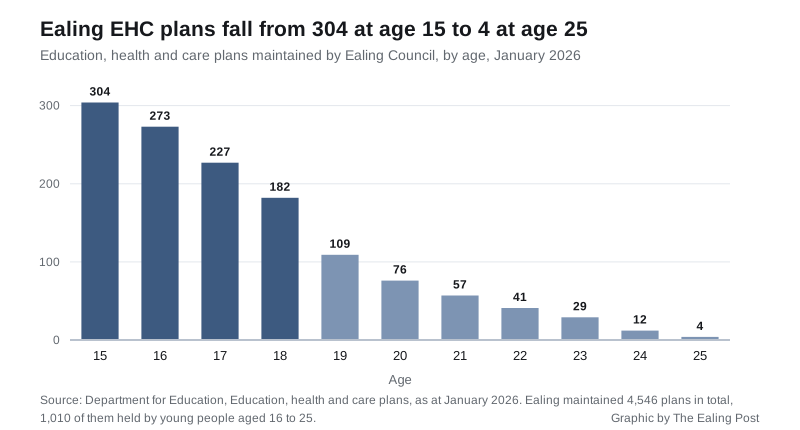
A plan can run to a person’s 25th birthday. Some of that fall is young people leaving because they no longer need a plan, and some is young people moving out of the borough. But the shape of it is the reason the charter’s founders point at employers rather than at schools: the support that exists at 15 largely does not exist at 22.
What the launch involved
The Duchess heard from young people with SEND, from employers and from local organisations about the barriers to work, UWL said. The event included a boccia match involving UWL and PACE Charitable Trust, which runs sport and leisure for people with disabilities, and a signed dance performance from IMPACT Theatre, a user-led charity working through the creative arts.
Professor Peter John CBE, UWL’s vice-chancellor and president, said in the university’s statement: “Every young person, regardless of need or background, should have the opportunity to develop skills, contribute to their community and access meaningful employment.”
The Duchess told the audience: “Thank you to Ealing and everyone in this Borough for doing what you are doing for these young people. You’re giving people chances and it’s making a world of difference to them, to their outlooks and to their families.”
UWL said graduates of its own supported internship programme have gone into paid jobs at Equans, Mencap and Next. The same visit marked the opening of the university’s new St Mary’s Road reception and the end of its campus building programme.
What it means for you
If you are a parent or carer of a young person with SEND in Ealing, the practical change is who you can ask. The Ealing SEND Network is the route named in the charter for matching young people to placements and for job coaching once a placement starts. Ealing’s SEND provision and support services are set out on the council’s local offer pages.
If you run a business in the borough, signing the charter commits you to offering something concrete: work experience, a supported internship, an apprenticeship or a paid job. Job coaching and matching come with it, which is the part employers most often say they lack.
The figure to judge it against is the one the partnership published itself. If 2.2% does not move towards London’s 7% over the next few years, the charter will not have worked, and that is a measurable test rather than a matter of opinion.
Note on the figures. The 2.2% and 7% employment rates are the founding partners’ own, as published by the University of West London. The plan counts are our own reading of the Department for Education’s published data for Ealing. They count education, health and care plans maintained by the council in January 2026, not every resident with SEND.
Sources
Have your say