
Ealing gets London's largest brownfield housing target in the draft London Plan: 32,054 homes by 2037, up 49%. Comments close 5pm on 15 October.
The Mayor of London’s draft London Plan gives Ealing a ten-year housing target of 32,054 homes. That is the largest brownfield-only target handed to any planning authority in London, and it is 49 per cent higher than the borough’s current target. The public consultation closes at 5pm on Wednesday 15 October.
The figures are in Table 3.1 of the draft plan, which covers 2027/28 to 2036/37. Policy HN1 tells councils they “should adopt and plan for the individual ten-year housing targets set out in Table 3.1”, and then plan for more capacity beyond that.
What changes for Ealing
The borough’s current target comes from Table 4.1 of the adopted London Plan 2021, which set 21,570 homes for 2019/20 to 2028/29.
- current ten-year target: 21,570 homes, about 2,157 a year
- draft ten-year target: 32,054 homes, about 3,205 a year
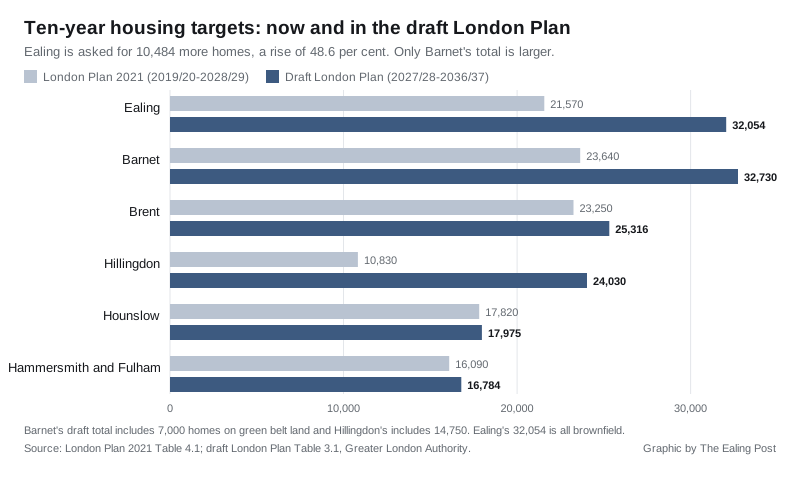
- the increase: 10,484 homes, or 48.6 per cent
- all of it is brownfield: the draft sets no green belt housing figure for Ealing
London’s total rises more slowly. The 2021 plan totalled 522,870 homes and the draft totals 558,451, an increase of 35,581. Ealing’s own increase of 10,484 is 29 per cent of that London-wide rise, on our arithmetic from the two published tables.
Only Barnet is asked for more homes in total, at 32,730. Barnet gets there with 7,000 homes on green belt land, so on brownfield alone Ealing’s 32,054 is the highest figure in the table.
Ten-year totals for Ealing and its neighbours in the draft plan:
- Ealing: 32,054, all brownfield
- Barnet: 32,730, of which 7,000 greenfield
- Brent: 25,316, all brownfield
- Hillingdon: 24,030, of which 14,750 greenfield
- Hounslow: 17,975, all brownfield
- Hammersmith and Fulham: 16,784, all brownfield
Under the 2021 plan those same boroughs were set 23,640 (Barnet), 23,250 (Brent), 10,830 (Hillingdon), 17,820 (Hounslow) and 16,090 (Hammersmith and Fulham). Hounslow and Hammersmith and Fulham barely move. Ealing and Hillingdon carry most of the increase in this corner of London.
The Old Oak and Park Royal Development Corporation, which is the planning authority for part of North Acton and Park Royal, moves the other way. Its target falls from 13,670 in the 2021 plan to 11,335 in the draft.
Where the plan points in this borough
Three Ealing places are named in the draft plan’s spatial strategy, set out in chapter 2.
- Hayes and Southall, and Old Oak and Park Royal, are Brownfield First Opportunity Areas
- Greenford is one of only five places London-wide in the plan’s “Brownfield Town Centre and Other” growth category, alongside Romford, Sutton, Woolwich and Kingston
- M40 (Northolt Area) is one of nine Green Belt Industrial growth locations, for storage and distribution
That last one matters, because it is the exception to the “no green belt housing in Ealing” line above. Ealing has no green belt housing figure, but the plan does identify green belt land in the Northolt area, shared with Hillingdon, for industrial growth. It is listed in Table C2 of the plan’s annexes.
The Vale in Acton is named for housing
Table 6.2 of chapter 6 lists eight industrial sites across London where, in the draft plan’s words, “development for housing-led schemes should be supported in advance of release from their industrial designation”. One of the eight is the whole of The Vale, in Ealing.
Ealing Council’s own Acton Town regeneration framework describes The Vale and South Acton as Locally Significant Industrial Sites and “important employment sites for a range of Ealing businesses”. It puts Acton Vale at about 98,500 square metres of floorspace.
That designation carries a figure with it. In Table 3.2, schemes of 36 homes or more on industrial land must provide 35 per cent affordable housing. The plan’s three location bands, which are mapped separately, are set at 35, 25 and 20 per cent.
The other targets in the draft
Ealing appears in several more tables in chapter 3.
| What | Ealing’s ten-year figure |
|---|---|
| Homes | 32,054 |
| Purpose-built student bedspaces | 2,003 |
| Older persons housing | 1,115 |
| Transitional supported housing | 130 |
| Gypsy and traveller pitches | 11 |
The student housing figure is the second highest in London, behind Barnet’s 2,127, out of a London total of 31,549 bedspaces.
Height and density
The plan is explicit that meeting these numbers on brownfield land means building more densely. It says “many more areas of London must embrace mid-rise development”, and defines the terms: low-rise is up to 12 metres, mid-rise is 12 metres up to 30 metres, a tall building is 30 metres or more, and a metropolitan tall building is 100 metres or more. Tall buildings are to be steered towards identified clusters rather than appearing case by case.
Ealing town centre is classified as a Metropolitan centre in the draft plan’s town centre network. Acton and Southall are Major centres, and Greenford and Hanwell are District centres.
What it means for you
The consultation is the point at which residents can argue with any of this, before it goes to a planning inspector.
- The deadline is 5pm on Wednesday 15 October 2026. Responses go through five separate online surveys, one per part of the plan, at consult.london.gov.uk/londonplan.
- Ealing Council is running a workshop on Tuesday 15 September, 6pm to 8pm, at Perceval House. The council says places are booked by emailing its strategic planning manager, Steve Barton, at BartonS@ealing.gov.uk. The details are in the council’s own notice.
- The targets are not the final word. The Mayor will consider responses in 2027, then submit the plan to the Secretary of State for an Examination in Public led by planning inspectors.
- If the target survives, the pressure lands on Ealing’s own local plan and on individual applications. Our Ealing planning news page tracks what is coming through the council’s register, and our house prices page tracks what the borough’s homes actually sell for.
Have your say